A Detailed Review of Site-Specific Wind Speeds for Tall Building Design in Dubai
Understanding the local wind climate is fundamental to the wind engineering design of tall buildings. In the Arabian Gulf, this requires more than simply determining a single extreme wind speed: different storm mechanisms can produce fundamentally different wind profiles and therefore different effects on a tall building.
Why Dubai requires a site-specific approach
The rapid development of tall and super-tall buildings in Dubai has created a particular need to understand the local wind climate and its implications for structural and serviceability design.
An important characteristic of the Arabian Gulf wind climate is that extreme winds can be associated with several distinct meteorological mechanisms. The study considered three principal types of event:
synoptic-scale storms;
thunderstorms; and
Shamal winds.
These events do not simply produce different wind speeds. They can also produce substantially different variations of wind speed with height.
That distinction becomes particularly important for tall buildings, where the wind conditions experienced hundreds of metres above ground can be very different from those measured by a conventional meteorological station near the surface.
Three different wind profiles
Conventional synoptic winds generally exhibit the familiar atmospheric boundary-layer profile, with mean wind speed increasing with height.
Thunderstorms and Shamal winds can behave differently.
The Shamal is a characteristic wind of the Gulf region, occurring predominantly during the summer months. Its development is associated with regional pressure systems, topography and strong day-to-night temperature variations.
At night, rapid surface cooling can produce a temperature inversion. This inhibits the normal vertical mixing of the atmosphere and can lead to the formation of a nocturnal low-level jet. The resulting Shamal wind profile can therefore be significantly different from the conventional synoptic profile.
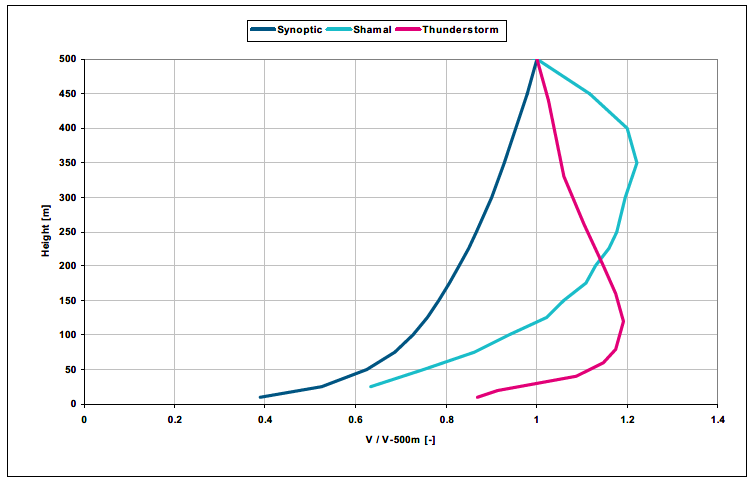
FIGURE 1 – Comparison of synoptic, thunderstorm and Shamal mean wind profiles, normalised.
This distinction is fundamental when determining design wind conditions. If different storm mechanisms are combined into a single extreme-value population, the resulting design wind speed may not adequately represent the vertical wind profile associated with the event producing that extreme.
For this reason, the different storm types need to be identified and considered separately.
Developing the site-specific wind climate
The analysis used approximately 20 years of surface wind records from three meteorological stations in the Arabian Gulf, namely Dubai International Airport, Abu Dhabi International Airport and Sharjah International Airport.
The records included information that allowed thunderstorm events to be identified and separated from the broader wind climate.
Identifying Shamal events required a different approach.
Because the maximum wind speed associated with a Shamal may occur well above conventional anemometer height, upper-level measurements were required. Weather-balloon measurements from Abu Dhabi International Airport were therefore examined, including measurements at approximately 110 m and 540 m above local sea level.
This provided a means of examining not only the magnitude of Shamal winds but also their behaviour through the lower atmosphere.
The importance of changing terrain
One of the most important practical issues in analysing historical wind records is often overlooked: the surroundings of the meteorological station may have changed.
This is particularly significant in a rapidly developing city such as Dubai.
A wind speed measured at an airport is affected by the buildings and terrain located upstream of the anemometer. As development occurs around the station, its exposure changes. Consequently, a wind speed measured in a particular direction in the 1980s may not be directly comparable with a measurement from the same direction twenty years later.
The Dubai records showed precisely this effect.
For westerly winds, the calculated terrain transposition factor was approximately 1.0 between 1988 and 1994, reducing to approximately 0.9 for 2000–2007 as development increased to the west of the airport.
The wind record itself showed a corresponding reduction in extreme recorded wind speeds from directions where development had increased.
For site-specific wind studies in rapidly developing cities, the historical evolution of the terrain therefore needs to form part of the analysis.
What did the extreme wind analysis show?
Once the different storm mechanisms had been separated and the surface measurements corrected for terrain effects, extreme-value analysis was undertaken to determine wind speeds for a range of return periods.
One particularly interesting result was the difference between the synoptic and thunderstorm wind climates in Dubai.
At a 50-year return period, expressed as a mean-hourly wind speed at 10 m height in open-country terrain, the analysis produced:
Synoptic wind: 17.6 m/s
Thunderstorm wind: 23.2 m/s
At first sight, this appears to suggest that thunderstorms should govern the wind design of a tall building.
But that is not necessarily the case.
The highest surface wind speed does not necessarily govern the building
This is perhaps the most important engineering outcome of the study.
Thunderstorms produced the higher extreme wind speed close to ground level. However, the vertical wind profile associated with a thunderstorm differs substantially from the profile associated with a synoptic event.
For return periods relevant to ultimate structural design, thunderstorm wind speeds can exceed the corresponding synoptic winds at lower levels of the atmosphere. At shorter return periods associated with serviceability design, however, the study found the synoptic events to be critical.
When the complete vertical profiles were considered, the implications became clearer.
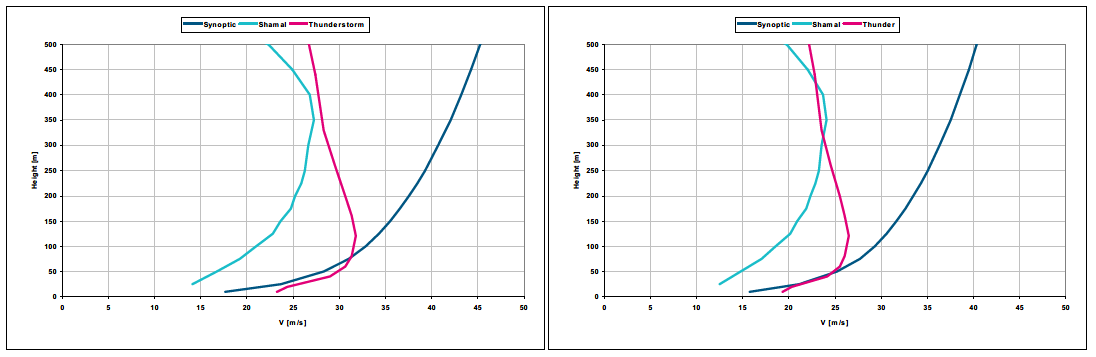
FIGURE 2 – Comparison between Synoptic, Thunderstorm and Shamal profiles, based on derived design wind speeds.
For the majority of tall buildings, the study concluded that parameters such as overall structural wind loads, wind-induced building accelerations, and much of the cladding pressure regime were likely to be governed by synoptic wind events.
Thunderstorms may nevertheless be important for cladding design at lower elevations. Their transient nature also means that the spatial correlation of loading across a large structure can be substantially different from that associated with a longer-duration, stationary synoptic event.
This demonstrates why selecting a design wind speed solely on the basis of the largest extreme value measured at 10 m can be misleading for a tall building.
What about Shamal winds?
Shamal winds present another interesting case.
The upper-level wind measurements indicated a distinctly different profile from a conventional synoptic event. Design wind speeds derived at approximately 110 m and 540 m were used to establish a representative Shamal profile for tall-building assessment.
When this profile was compared with the corresponding synoptic and thunderstorm profiles, the study found that Shamal events were not the governing condition for either structural or serviceability design for the case considered.
This conclusion was also examined separately through boundary-layer wind-tunnel testing using representative synoptic and Shamal wind profiles. The study nevertheless noted that Shamal profiles can vary significantly and that further investigation of this variation was required.
Related article: The Impact of Shamal Winds on Tall Building Design in the Gulf Region
What does this mean for tall-building wind engineering?
The study highlights a broader point about site-specific wind climate assessment.
A design wind speed should not necessarily be regarded as a single number independent of the meteorological event that produced it.
For a tall building, the relevant questions are also:
What type of storm produced the extreme wind?
How does its wind speed vary with height?
How has the terrain surrounding the meteorological station changed during the measurement period?
Which storm mechanism governs the particular design response being considered?
The answers may be different for overall structural loading, occupant comfort, building accelerations and local cladding pressures.
Conclusions
The analysis of the Dubai and wider Arabian Gulf wind climate demonstrated the importance of separating different storm mechanisms when deriving site-specific design wind conditions.
The study found that Dubai's extreme surface wind climate can be strongly influenced by thunderstorms. However, because thunderstorm and Shamal wind profiles differ from conventional synoptic profiles, the largest extreme wind speed measured near ground level does not necessarily govern the response of a tall building.
For the conditions investigated, synoptic events were considered critical for overall structural loading, while thunderstorms could become important for cladding at lower levels. Shamal winds were not found to govern the designs examined, although their unusual vertical profile and potential variability warranted further investigation.
The work also demonstrated the importance of accounting for the historical development of the terrain surrounding meteorological stations — particularly in rapidly developing cities such as Dubai.
Ultimately, a robust site-specific wind climate study requires more than statistical analysis of the largest recorded wind speeds. It requires an understanding of the meteorology, terrain, vertical wind structure and engineering response of the building itself.
Publication
Leighton Aurelius, Buttgereit, V., Cammelli, S. and Davids, A.
A Detailed Review of Site-Specific Wind Speeds for Tall Building Design in Dubai.
RELATED RESEARCH
Shamal Winds and Their Influence on the Wind Climate of the Arabian Gulf
An examination of Shamal wind events and their influence on the regional wind climate, providing further context for the assessment of extreme winds and site-specific design wind speeds in the Arabian Gulf.
